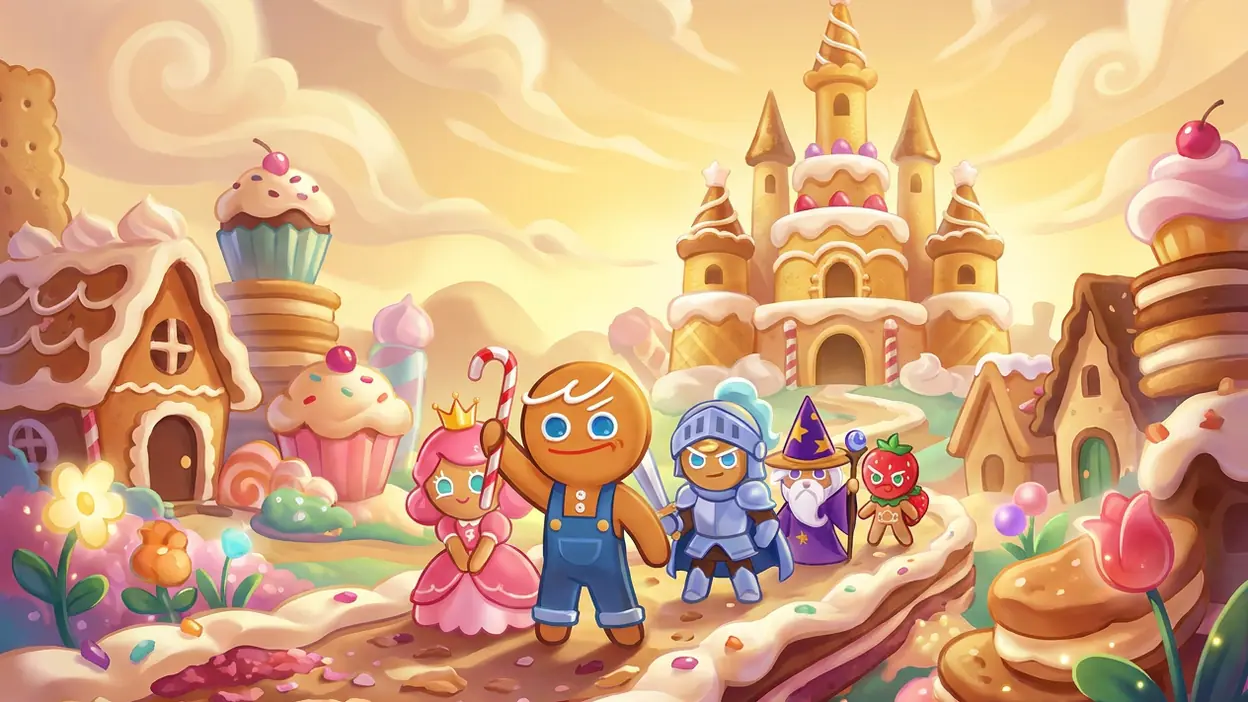
CookieRun: Kingdom Turns Community Into Part of the Daily Grind
Analysis byAppsAward
CookieRun: Kingdom makes a kingdom feel less like a private base and more like a place other people might notice. You build it, send a team of cookie heroes into battle, and return to a busy calendar of events and social competition. The community is not a separate chat layer bolted onto the role-playing game: it grows out of shared goals, collectible characters, and the urge to show what you have made. That gives the game a strong social pulse, but also means its best connections are often shaped by progression and routine.
A kingdom built to be seen
The core rhythm is familiar: clear stages, strengthen your roster, improve buildings, and expand your kingdom. What changes the mood is that the kingdom is both workshop and display case. Its decorations, production buildings, and wandering cookies make progress visible. Visiting another player’s kingdom turns that private construction loop into a small social exchange: a quick look at their layout, their priorities, and how far they have come.
This is a gentler kind of participation than a live-action game built around voice chat or constant coordination. You can spend a few minutes tending production and collecting rewards without needing to perform for a group. Yet the wider game keeps nudging you toward other players through guild membership, competitive rankings, and limited-time goals. The result is a community with several speeds: casual visitors can decorate and check in, while ambitious players can organize around optimization and competition.
Participation has more than one tempo
The game’s social model is layered. At the lightest level, a player maintains a kingdom and follows the campaign at their own pace. At the next level, they compare progress with friends or other players and take part in the game’s competitive modes. Guilds ask for a more durable commitment: members contribute to shared activity and join coordinated efforts, including guild-focused battles. The stronger the commitment, the more the game’s community becomes part of a player’s weekly schedule.
That progression is effective because it does not make every player socialize in the same way. A decorated kingdom can communicate personality without a long conversation; a guild can provide a reason to return and a common target. But the layers are not equally meaningful. Kingdom visits can feel like a pleasant tour, while competition and guild contribution are more likely to affect rewards and standings. The game’s network value is therefore strongest for players who want goals that extend beyond their own account.
Newcomers enter through cookies, not clubs
For a newcomer, the most welcoming invitation is the cast. Distinct designs and character personalities make collecting feel like an introduction to the world, while campaign stages provide a clear first task. New players can learn the basic loop before they have to understand guild expectations or competitive team-building. The kingdom itself also gives them something concrete to shape early, instead of asking them to arrive with an existing social circle.
That gradual entry has a limit. A new player may see established kingdoms, developed rosters, and event rewards that signal how much time long-time users have invested. Competitive modes can make the gap feel more obvious than the story does. CookieRun: Kingdom gives beginners room to learn, but it cannot erase the advantage of account age, character collection, and accumulated resources. A friendly first impression is not the same as an even playing field.
Players who want to join a guild can treat it as a second doorway, but choosing one involves a different kind of judgment: how active its members are, what expectations it sets, and whether its pace suits a newcomer. The game can provide the structure for that relationship; it cannot guarantee that every group is patient or welcoming. In practice, the best route in is to build confidence through the solo loop, then seek a guild whose demands match the time you actually want to give.
Rituals keep the social world moving
CookieRun: Kingdom thrives on repetition. Players collect production, upgrade buildings, improve cookies, clear available content, and check what the current event is asking them to do. Guild participation adds a recurring obligation, while competitive cycles give players a reason to revisit teams and watch their standing. These rituals create continuity: logging in is not just a fresh start, but another small contribution to a kingdom or group that already exists.
Events are especially important to the community’s rhythm. They give players a shared subject, a deadline, and often a fresh set of rewards to discuss or pursue. A limited window can make a quiet week feel active, and the same event can serve different appetites: one player may chase completion, another may focus on rewards, and a guildmate may simply compare progress. That variety helps the game sustain conversation without requiring every player to pursue the same ideal account.
There is a cost to this cadence. A game that rewards regular attention can turn a charming routine into a checklist, particularly when several systems compete for the same session. Players who miss days may feel they have fallen behind, even if they are still enjoying the story. The community’s energy and the game’s event schedule are closely linked, so the social calendar can feel less inviting when it starts to resemble homework.
Players contribute through play and presentation
Not every contribution needs to be an elaborate guide or a popular fan account. In-game, players contribute by developing their kingdoms, testing teams, helping guild efforts, and sharing progress with friends. Outside the game, a character-heavy roster and a distinctive visual style give fans plenty to interpret and remix. Art, jokes, character rankings, strategy advice, and reactions to new content are natural forms of participation for a game built around a broad cast and collectable heroes.
Those fan activities should not be confused with official support or guaranteed in-game influence. Community-made advice can help players understand team choices and progression priorities, but its value depends on context: a recommendation for a well-developed account may not work for a beginner with a smaller roster. Likewise, fan creations can extend the game’s cultural life without changing its rules. The most useful community content is the kind that explains its assumptions rather than presenting one build or route as universal.
Sharing also gives the kingdom-building system a purpose beyond efficiency. A player can arrange a space to feel playful, orderly, crowded, or deliberately extravagant. That is a quieter contribution than topping a leaderboard, but it gives the community something personal to look at. In a roster-focused role-playing game, not every expression of identity has to come from winning; it can come from what a player chooses to keep and how they arrange it.
Competition can bind players and wear them down
Competition gives guilds and rankings their edge. A shared battle can turn individual upgrades into collective progress, and a stronger opponent gives a group a reason to coordinate and improve. For players who enjoy optimizing teams, this is where the game’s social layer becomes most concrete: decisions matter to other people, not just to a personal campaign record.
That same structure can create friction. Differences in activity, roster strength, or expectations can make a guild feel like a burden for someone who only wants a casual game. Competitive standings also invite comparison, and comparison is harsher when progression depends on time and collection as well as tactical decisions. Some players will find that pressure motivating; others will find that it narrows the pleasure of building a kingdom into the question of whether it is competitive enough.
There is another tension between advice and status. Experienced players can make a community more helpful by explaining systems, but a flood of optimization talk can make newcomers feel that there is one correct way to play. CookieRun: Kingdom is at its best when strategic knowledge opens choices rather than policing them. A decorative kingdom, a favorite cookie, or a slower campaign pace should remain valid ways to enjoy it.
Moderation is the part players should not assume
Any game with groups, player identity, and community discussion raises practical questions: how reports are handled, how active moderation is, what tools exist for blocking or limiting contact, and how well rules are enforced. Those details can change over time and may differ between in-game spaces and community channels outside the game. Without checking the current tools and policies directly, it would be irresponsible to claim that every interaction is well protected or that every group is safe by default.
Players should approach guilds and external fan spaces with ordinary caution. Be wary of pressure to share personal information, account details, or money, and use the game’s current reporting and privacy controls where needed. Parents and younger players should check the latest age guidance and communication settings rather than assuming the bright art style tells the whole story. The game’s friendly presentation does not remove the need for clear boundaries.
This uncertainty is not unique to CookieRun: Kingdom, but it matters because the game’s strongest social experiences depend on repeated contact. A guild that works well can make routine play warmer and more purposeful; a poorly matched one can turn that same routine into obligation. The presence of community features creates opportunity, not a guarantee of good moderation or good manners.
Network value, and the question of staying power
The community adds value in three connected ways. It gives players examples to learn from, makes progress easier to share, and creates common goals that can outlast a single story stage. Those benefits reinforce the game’s collection and kingdom loops: a new cookie can inspire strategy discussion, an event can bring guildmates back, and a visit can make someone else’s kingdom feel like a small window into their play style. Social activity gives the game more texture than a purely solo campaign would have.
Its durability depends on whether those loops remain rewarding without demanding constant attention. A large cast and a customizable kingdom provide plenty of material for fan interest, while events and group competition offer reasons to return. But a community can thin out if players feel that keeping up matters more than having fun. Long-term health requires room for different levels of commitment, and for returning players who have missed part of the calendar.
Compared with a quick puzzle game such as Brain Test: Tricky Puzzles, CookieRun: Kingdom asks for a more sustained relationship: its social value accumulates through an account, a roster, and repeated group activity. That is a real advantage for players who want a home base and familiar names to return to. It is a poorer fit for someone who wants a game that can be played occasionally without any sense of falling behind.
The community is not merely decoration around CookieRun: Kingdom; it is one of the reasons its routine can feel alive. Kingdom visits offer low-pressure expression, guilds give progress a shared purpose, and fan contributions carry the cast beyond the game itself. The trade-off is a social life tied to regular play, competition, and systems whose moderation details deserve attention rather than assumption. My verdict: this is a rewarding community ecosystem for players who enjoy showing up, sharing progress, and building alongside others, but its warmth is strongest when participation stays optional rather than becoming another daily obligation.
More articles
View all