Spotify Review: Excellent Discovery, Despite an Interface That Keeps Getting Busier
Analysis byAppsAward
The best thing Spotify does is not play music. It is make the next good choice feel close at hand, whether you have ten seconds before leaving home or an entire afternoon to fill. Plenty of streaming apps can deliver a track on request; Spotify: Music and Podcasts has built its case on the handoff between what you already love and what you might want next. That instinct makes it one of the most useful entertainment apps on a phone, even as its increasingly busy design sometimes gets in its own way.
Spotify has become familiar enough to fade into routine: a commute playlist, a podcast in the kitchen, a song sent to a friend. Familiarity can hide how much the app is doing. Its strongest work is quietly editorial. It sorts a huge catalogue into starting points, remembers enough to feel personal, and keeps playback ready across devices. The result is less like opening a digital record shop and more like walking into a room where someone has already put on something worth hearing.
Why Spotify deserves the spotlight
Spotify earns its place not through one exclusive feature but through the way its pieces reinforce one another. Search is direct when you know what you want. The Home feed is there when you do not. Your library holds saved albums, playlists, and episodes, while the app’s recommendation surfaces keep proposing routes out of your habits. This balance matters: a service built only around searching makes discovery feel like work; one built only around recommendations can make listening feel like surrender.
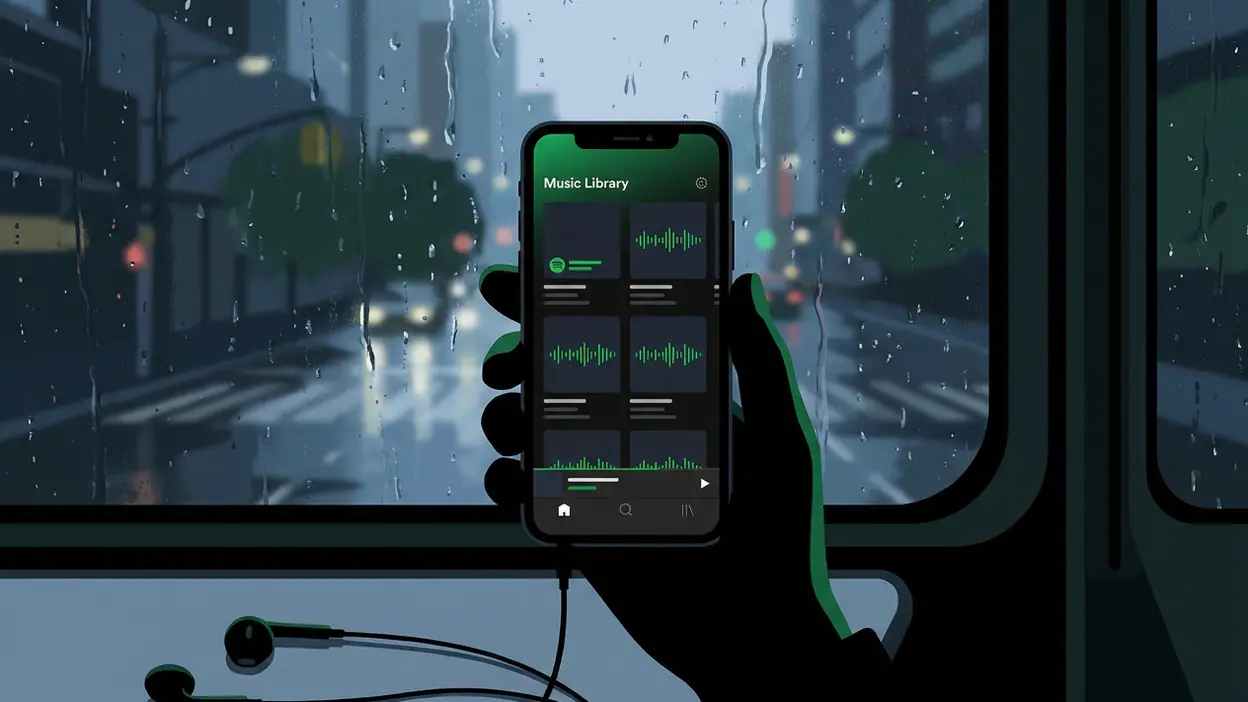
The mobile app handles both modes with little ceremony. Type an artist, album, lyric fragment, or podcast into search and you can usually get somewhere useful quickly. On another day, a personalized mix or a playlist assembled around a mood can save you from browsing. Spotify is at its best when it turns an idle moment into a small, satisfying decision rather than asking you to manage a catalogue.
It also understands that listening is rarely a single-device activity. You might start a record on your phone, move playback to a speaker, then return to headphones on the way out. Spotify Connect makes that shift feel practical rather than technical, giving the service a strong role in the daily life of a household as well as an individual listener. That continuity is part of the product, not a bonus feature.
What feels exceptional from the first session
The first impression is speed of orientation. The app can be visually dense, but its essential gestures are familiar: tap a recommendation, save what you like, return to recent listening, or search. A new user does not need to understand every playlist label to start playing something. That low barrier is easy to underestimate, especially in an app whose catalogue is large enough to make choice feel intimidating.
Discovery is the more distinctive pleasure. Daily mixes and other personalized playlists can be impressively well judged, particularly when they blend dependable favorites with a few less obvious picks. The value is not that every recommendation lands; no system can read a listener perfectly. It is that Spotify gives you enough promising options that a miss rarely ends the session. A good recommendation can lead to an artist, then an album, then a track you keep returning to long after the playlist has moved on.
The app’s treatment of albums and playlists also respects how people actually listen. You can follow a familiar queue without fuss, but there is room to wander through an artist’s releases or explore a genre. Spotify does not always make those paths equally visible, yet the underlying catalogue and saved-library tools give curious listeners plenty to work with. For me, its most satisfying moments are often modest: finding a long-forgotten song in an old playlist, then letting autoplay take the evening somewhere unexpected.
How it earns attention over time
Spotify’s stickiness comes from memory. The service builds a record of what you play, save, skip, and revisit, then uses that history to shape a listening environment that feels increasingly familiar. The effect is not magic, and it can become circular if you never push beyond your usual artists. But the app lowers the cost of returning. Your recent listens are close, your saved music is waiting, and a playlist can supply an immediate soundtrack without requiring a fresh plan.
That memory also makes the service social in a light-touch way. Shared playlists and listening links let music travel between people without turning the app into a full social network. A friend can send you a track and you can move from that one song into the artist’s wider catalogue. Music remains the point, which is a welcome restraint in a product landscape that often tries to turn every interaction into a feed.
Podcasts extend the routine beyond music. Keeping spoken-word shows beside albums is convenient for anyone who moves between listening modes throughout the day. Spotify can be the place you open for a new episode in the morning and a carefully chosen record at night. That breadth is practical, though it also adds complexity: music and podcasts do not always call for the same discovery tools or the same kind of queue management.
The best moments happen between tasks
Spotify shines in the gaps. Walking to a bus stop, cooking with one hand free, winding down after work: these are situations where the app’s quick access and reliable playback matter more than a perfect recommendation engine. A saved playlist can start the moment without ceremony. If your mood changes, search or the Home feed can offer a new direction before the silence becomes annoying.
It is particularly good at turning a simple request into a longer session. You play one song, follow an artist, notice an album, and end up listening to more than you planned. This is not always a virtue—autoplay can keep the evening moving when you meant to stop—but it reveals Spotify’s central talent. It makes the space between intention and discovery feel short.
There is a different pleasure in using Connect at home. Being able to direct playback to a compatible speaker from the phone is a natural fit for a service people use while doing other things. The controls stay close, while the music fills the room. Spotify feels less like a collection of files and more like a dependable layer over ordinary life.
A quieter edge over louder rivals
Spotify’s advantage is not that it does everything better than every competitor. It is that its everyday listening loop is unusually legible: find something, play it, save it, share it, or let the next choice arrive. Rivals may make stronger claims about exclusives, lossless audio, or particular artist relationships, and serious listeners should compare those details against their own priorities. Spotify’s case is broader and more mundane, which is exactly why it works: it is easy to live with.
Compared with apps that compete for attention through constant spectacle, Spotify generally keeps the focus on the next thing to hear. Its playlists and personalized selections can be prominent, sometimes too prominent, but the service does not need a game-like loop or a social feed to make an ordinary listening session compelling. That restraint is an editorial strength. It leaves room for music to be the main event.
The caveat is that the interface has grown crowded as Spotify has expanded its ambitions. Home can place music, podcasts, recommendations, and promotional surfaces close together, making the simplest destination less obvious than it should be. A streamlined music player is not the whole product anymore; the app wants to be a broad audio hub. Its challenge is to make that breadth feel useful instead of noisy.
Where it still needs polish
Navigation can feel less settled than the playback itself. Labels and surfaces shift over time, and a feature that was easy to find can move as the app changes. Frequent listeners adapt, but familiarity should not have to mean relearning the layout. Spotify would benefit from clearer distinctions between the places where you browse, the places where you manage your collection, and the places where the service promotes a new listening option.
Recommendations also bring a familiar trade-off. The more accurately Spotify predicts your habits, the easier it is to hear the same territory again. Personalized playlists are most useful when they take a modest risk, not when they simply rearrange familiar artists. The strongest discovery sessions are those that introduce a new voice without losing the thread of what you came to hear. Spotify can do this well, but the balance is uneven.
Podcast listening has its own friction. A spoken episode may call for different queue behavior and browsing cues from an album, and bringing both formats together can blur those needs. The convenience is real, but the interface does not always make the distinction feel thoughtful. Meanwhile, the free experience and paid plans differ in ways that can affect how satisfying daily use feels; users should check the current plan terms and regional availability before choosing. Spotify’s core strengths remain clear, but its expanding feature set needs sharper prioritization.
Who should care most
Spotify is an especially strong fit for listeners who move between familiar favorites and new finds, and who want one dependable app for music and podcasts. It suits people who listen in short bursts throughout the day, households that send audio between devices, and anyone who values playlists as a way to get started rather than as a substitute for choosing.
It may be less compelling for someone whose decision rests on a very specific audio-quality requirement, a particular catalogue gap, or a preference for a quieter, more traditional music library. Those listeners should test the service against their own needs rather than assume its popularity settles the question. Spotify’s breadth is its appeal, but breadth is not the same as a perfect fit for every ear.
Why it belongs in this moment
Audio has become the companion medium of modern routines: present during travel, chores, exercise, and the stretches of work that benefit from a soundtrack. Spotify understands that listening is not always an event that demands full attention. Its best design choices make it easy to press play, carry on with life, and return when a song catches your ear. That quality is more meaningful than another layer of novelty.
At the same time, the app has cultural reach because it makes listening personal without sealing it off from other people. A playlist can capture a mood, a link can pass a discovery along, and a familiar artist can become the doorway to a new one. The service works as both utility and habit: a place to retrieve the songs you know, and a machine for finding the next one worth keeping.
Spotify’s real craft is making a vast catalogue feel like a personal recommendation rather than a warehouse. That craft is less visible than a headline feature, but it is what keeps the app in daily rotation. When the interface gets crowded, the central idea remains intact: music should be easy to reach, and discovery should not require a project.
The editor’s verdict
Spotify: Music and Podcasts deserves an Editor’s Choice for the quality of its everyday judgment. Its recommendations can surprise, its playback travels comfortably between devices, and its library gives listeners a reliable home for both planned and accidental favorites. It is not flawless: the crowded Home feed, occasional discovery loops, and imperfect separation of podcasts from music all deserve attention. Yet few audio apps make it this easy to turn a passing impulse into a satisfying hour of listening. Spotify is not merely where I go to play a song; it is where I expect to find the next one.
More articles
View all