Google Earth Shows Travel Apps Should Help Us Understand Places Before Booking
Analysis byAppsAward
Most travel apps begin with a question like where to sleep or how to get there. Google Earth begins earlier: what does this place actually look like, and how does it fit into the world around it? That difference points to a quiet shift in travel software. The category’s next standard should not be a faster checkout alone, but a better sense of place before anyone commits money or time.
That is a big claim for an app best known as a globe you can zoom into. Yet that globe remains unusually useful. It turns a destination from a name in a search result into terrain, coastlines, neighborhoods, and landmarks you can inspect at your own pace. The experience is not a replacement for booking tools or turn-by-turn directions. It is a reminder that travel apps can do more than move users through a transaction.
Travel software has to explain places, not just sell access
The baseline has risen across Travel & Local. People expect location search to be quick, maps to load reliably, and results to reflect where they are and what they need. They expect useful details without a maze of menus: an address, a route, a place to stay, a way to compare options. On a small screen, a few seconds of uncertainty can send someone back to search.
That baseline is necessary, but it has also made many apps feel interchangeable. A hotel can be a pin, a price, and a row of photographs. A city can become a list of attractions sorted by popularity. These tools answer practical questions well, but often leave the most human question untouched: what will it feel like to be there?
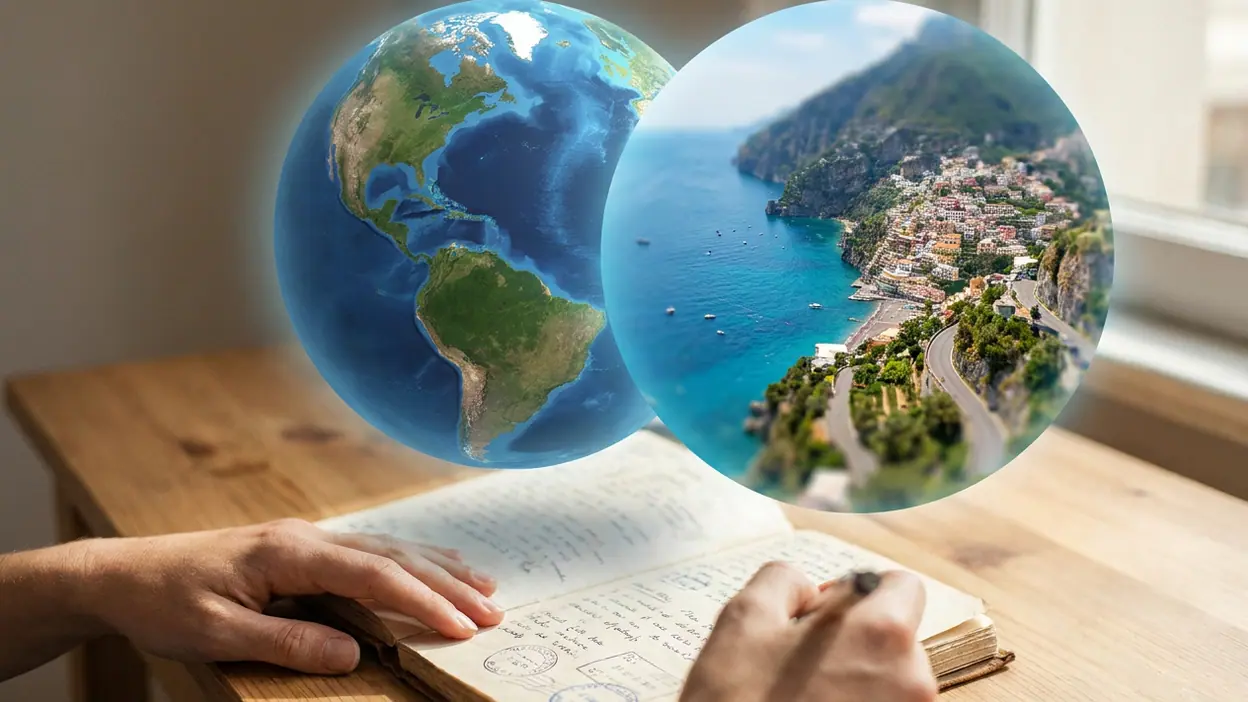
Google Earth is strongest precisely where those interfaces become thin. Its satellite and aerial imagery let users move from a global view to a closer look at a particular area, then tilt the map to read the shape of the landscape. The movement has a physical quality: a destination does not arrive as a card; it comes into view. That makes the app valuable for the early, curious part of planning, when a traveler is still learning rather than choosing.
The experience rewards aimless exploration as much as a specific search. I can follow a coastline, compare a city’s edges with its center, or look at the geography around a landmark before deciding whether it belongs on an itinerary. The key signal is not simply that Earth has impressive imagery. It is that orientation is a travel feature, not decorative material to place behind a booking button.
In other respects, Google Earth follows familiar map conventions. It depends on search, recognizable place names, layers of geographic information, and gestures people already understand from touchscreens. It lets users zoom, pan, and change their perspective rather than asking them to learn a new way to navigate. Its broad coverage also reflects the category’s basic promise: a traveler should be able to start almost anywhere and make progress.
That familiarity matters. A globe that looked beautiful but resisted practical exploration would be a novelty, not a dependable app. Earth’s established mapping vocabulary gives its more expansive view a useful frame. The product does not ask users to abandon ordinary maps; it gives them another way to see what a flat route or a list of search results cannot show.
Its real challenge to convention is the refusal to treat travel as a sequence of purchases. Booking.com: Hotels & Travel, Expedia: Hotels, Flights, Cars, and Airbnb are built around decisions that can be priced, filtered, and confirmed. That is sensible work, and these services have earned their place by making it easier to find a bed, compare a trip, or rent a home. But their interfaces naturally make the destination legible through inventory: rooms, rates, dates, and amenities.
Google Earth starts with the setting rather than the supply. It encourages a traveler to inspect the place before turning it into a booking decision. The contrast is not that one kind of app is useful and the other is not. It is that the category has long treated logistics as the central problem, while understanding the destination is left to scattered searches, photographs, and guesswork.
Related products show why that transaction-first approach persists. Booking.com and Expedia make comparison their core service; Airbnb places accommodation and host-led context at the center. Upside: Gas & Food Cash Back, though aimed at a different stage of a trip, makes the practical side of travel visible through nearby fuel and food rewards. Each app has a focused job. Taken together, they reveal a category organized around the moments when a user spends, saves, or reserves.
There is nothing wrong with that focus. The stale convention is assuming that a travel app has done enough once it has put an option in front of the user. A listing can show a property’s interior and still tell little about its surroundings. A route can give a distance without giving a feel for the terrain. A discount can reduce the bill without helping someone decide whether the detour is worth taking. Earth’s strongest contribution is to make the surrounding world part of the decision.
That points toward an emerging standard: travel tools should connect logistics to geographic context. A room search should make it easy to understand the neighborhood, not just compare nightly prices. A route should help users recognize the landscape they are crossing. A place page should offer enough visual and spatial information to answer whether it fits the trip. This does not mean every app needs a virtual globe. It means location should be more than a coordinate attached to a commercial result.
Google Earth demonstrates the value of that standard, but also the limits of its own approach. Its visual depth cannot guarantee that a street is lively at night, that a path is accessible, or that a restaurant is open today. Satellite imagery may be old, and a dramatic aerial view does not provide the current, on-the-ground detail people need for a final decision. Exploration can help users form questions; it cannot answer every one of them.
There is also a practical handoff problem. A curious traveler may discover an appealing area in Earth, then need a separate service for current opening hours, transit options, lodging availability, or directions. That separation is understandable: different products specialize in different data and tasks. Still, it leaves users to assemble a trip from fragments. The category’s lag is not a shortage of maps or booking inventory, but a shortage of thoughtful connections between them.
The consequence for users is straightforward. Better geographic context can prevent a poor choice before it becomes an expensive one. It can help someone notice that a hotel is far from the places they want to visit, understand why a road winds around a mountain, or spot how a waterfront district relates to the rest of a city. It can also make planning enjoyable rather than purely administrative. There is real value in being able to wander visually before the calendar and budget take over.
That pleasure is part of the app’s stickiness. Google Earth is not something most travelers need open all day, and it does not replace a navigation app during a walk. Its appeal is episodic: open it when a place catches your interest, explore until the geography makes sense, then carry that understanding into the practical tools. Its best use is not constant engagement but a lasting change in how a destination is pictured.
Travel apps will keep competing on live information, convenience, and price. Those are essential, but they are no longer enough to define a good experience. The category needs to treat the destination itself as a first-class part of planning, with clear links between what a place looks like, what is available there, and how a traveler will move through it. Google Earth does not complete that journey, and its imagery has limits. It does, however, make the missing step impossible to ignore: before travelers book a place, they should be able to understand it. That is the standard the category should now be building toward.
More articles
View all