
- Award score
- 4.7Rating
- 10,000,000+installs
- Free
App information
- Version
- 1.22.0
- Updated
- Requires
- 7.0
- Price
- Free, in-app purchases
- Developer
- Oakever Games
- Content rating
- Everyone
Screenshots
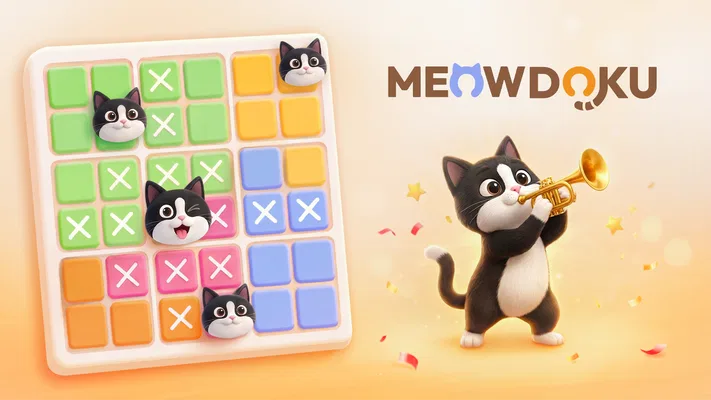
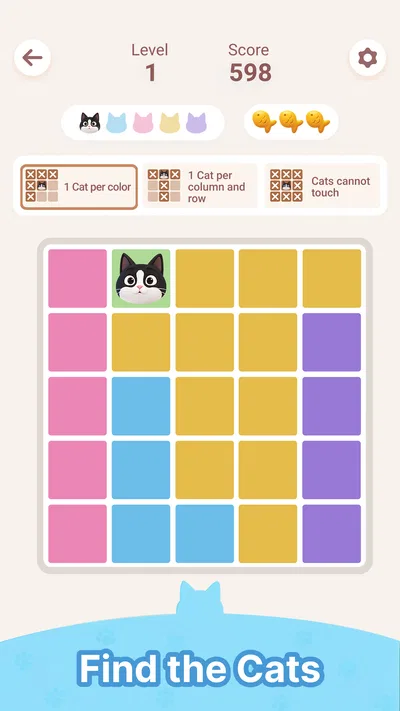
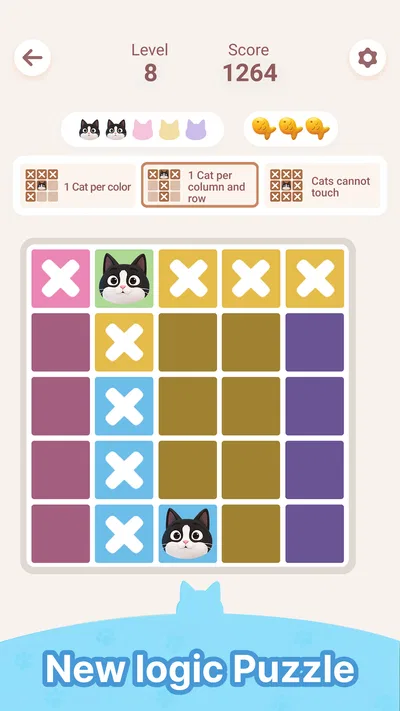
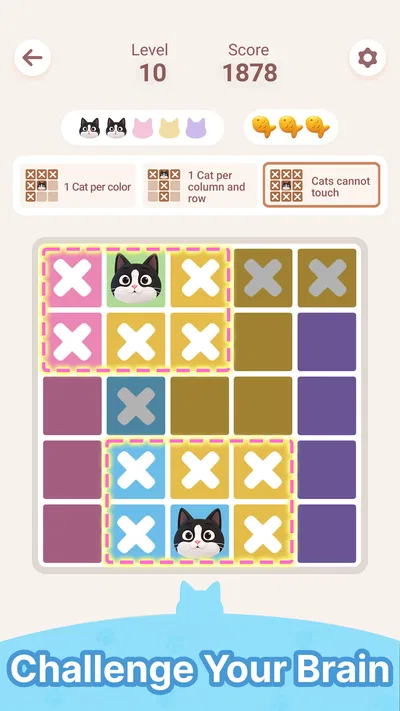
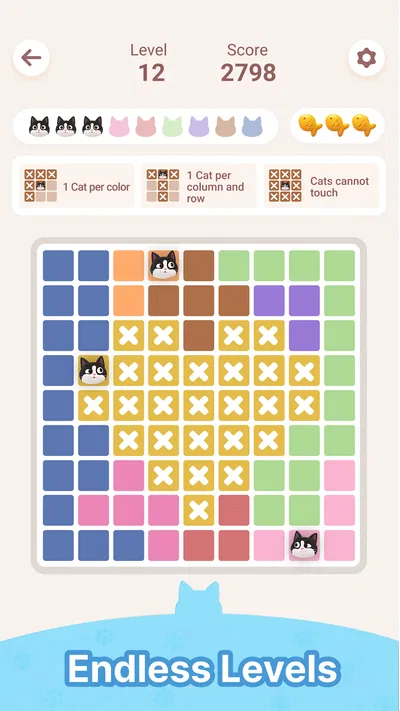
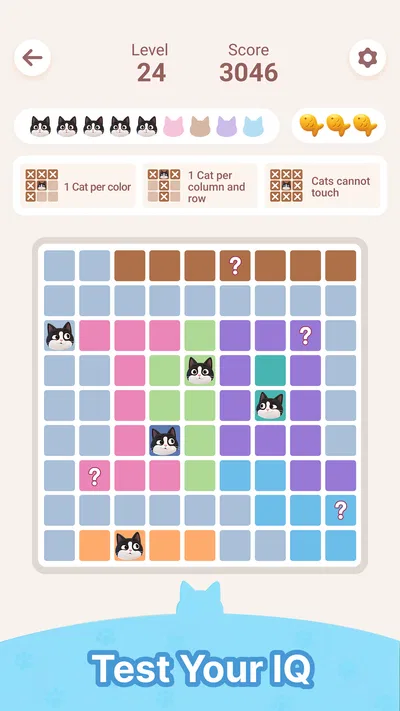
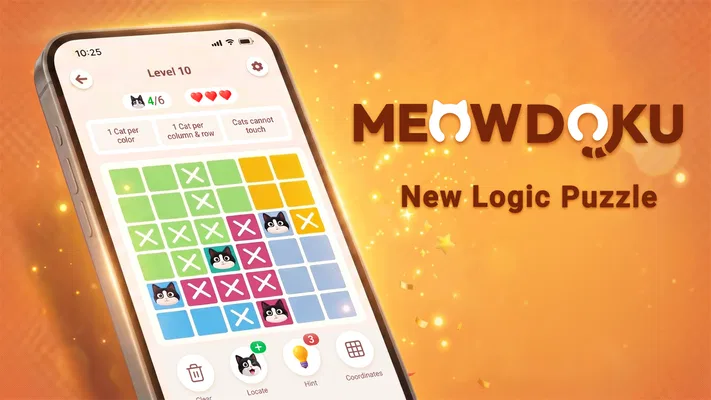
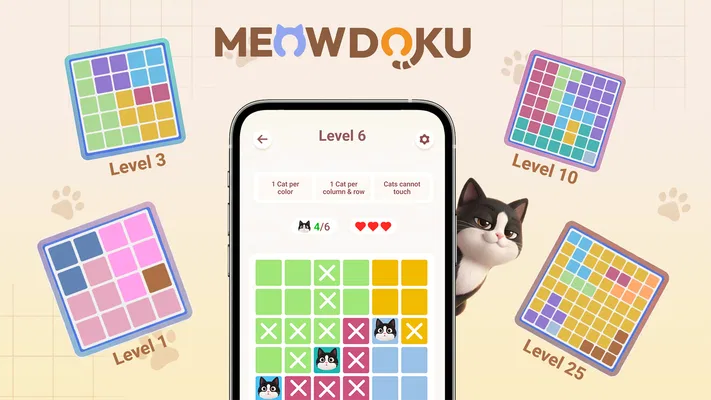
 Analysis byAppsAward
Our review of Meowdoku: Brain Puzzle Games
I’m drawn to puzzle games that make me stop and reason rather than simply react, and Meowdoku has a promising twist: its grid logic sits between Sudoku and Minesweeper, with cat territories to work out. That gives each move a small sense of discovery. In my view, it is most appealing to people who like careful deduction and want a puzzle they can approach at their own pace, though the grid-based play may not suit everyone equally well.
Reading the grid and finding your way through a puzzle
Meowdoku: Brain Puzzle Games is a free puzzle game from Oakever Games. Its central idea is easy to explain, but the appeal comes from interpreting clues and deciding where each cat’s territory belongs. That blend makes it feel different from a standard Sudoku board: instead of concentrating only on number patterns, I’m trying to make sense of a spatial arrangement.
The basic premise should be approachable if you have played either Sudoku or Minesweeper, even if you are not an expert at both. Familiarity with those games gives you a useful starting point, but the combination still asks you to learn how its clues work together. I would expect the first few puzzles to be more about understanding the rules than finding an elegant solution. That learning curve is part of the experience, not a reason to rush.
For readability, the key question is whether you can comfortably distinguish the grid, clues, and your own decisions on your device. The game is built around a board, so the screen’s available space matters more than it would in a word puzzle with a simple vertical layout. On a larger phone or tablet, the board may feel easier to inspect; on a compact screen, I’d take time to check whether the cells remain comfortable to follow before settling in for a long session.
The most useful way to approach a tricky board is to avoid scanning every cell repeatedly. I find it easier to focus on one clue or one promising region, identify what it rules out, and then move on. That small workflow helps keep the puzzle mentally organized, especially when several deductions depend on one another. If you enjoy making notes mentally and revisiting a board with fresh eyes, this style can be satisfying. If you prefer a game that always tells you what to do next, it may feel demanding.
The game’s scale suggests that plenty of players have found the premise worth trying: it has more than 10 million installs and an average rating of 4.7 from around 546,000 ratings. Those figures are useful context, but they don’t tell me whether its visual presentation will work for a particular player. I’d treat them as evidence of broad interest, not a guarantee that every screen or puzzle will suit your needs.
Small-screen comfort and control
A logic game generally gives the player more time to inspect a board than an action game does, and that is a meaningful advantage here. You can think before committing to a move rather than needing split-second reactions. For someone who finds fast tapping stressful, that slower rhythm may make the puzzle easier to approach. The trade-off is that careful inspection can become tiring if the board feels cramped or if distinguishing neighboring cells takes extra effort.
I would test the game in the way I expect to play it: hold the phone naturally, look at a board for a few minutes, and notice whether I’m straining to see details or repeatedly correcting taps. A comfortable grip matters because this is a screen-centered activity. If a device feels awkward in one hand, using both hands or setting it on a stable surface may make the task less fiddly. These are practical adjustments rather than special game features, but they can change how enjoyable a logic session feels.
Touch-based grid play can also be a mixed experience for people with reduced dexterity, tremor, or difficulty making precise selections. A puzzle may be slow-paced yet still require accurate tapping. I can’t assume that every cell is easy to select for every hand or device, so anyone who relies on generous touch targets should check that the board feels manageable before investing time in a difficult run. A wrong tap can be especially frustrating when you were confident in the deduction.
There is a sensory consideration too. A logic board asks for sustained visual attention, which can be tiring for players who are sensitive to dense patterns, contrast, or prolonged screen use. I’d recommend short sessions and breaks rather than trying to push through eye strain. The game’s Everyone age rating signals broad age suitability, but age suitability and individual comfort are different questions; a puzzle can be appropriate for a wide audience and still be visually demanding for some people.
When the game fits into everyday life
Meowdoku makes most sense in quiet gaps when you have enough attention to follow a chain of deductions. I can picture opening it during a waiting-room pause or while taking a break at home, then stopping once I reach a natural point. It is less suited to moments when I’m being interrupted every few seconds: a half-remembered clue can make it harder to return to the same reasoning, and the game is more rewarding when I can give the board a little focus.
For short breaks, I’d choose a puzzle that looks manageable rather than starting with the expectation of finishing immediately. That avoids turning a relaxing diversion into a race against the clock. If I’m interrupted, I would mentally note the clue or region I was examining before putting the phone away. This simple habit helps me resume without restarting my whole scan of the grid.
The slower, logic-first format also makes it a better fit for someone who wants to play without reflex pressure. Compared with a typical action puzzle, it asks more of your pattern recognition and less of your reaction speed. Compared with classic Sudoku, it offers a different kind of spatial deduction; compared with Minesweeper, the cat-territory theme changes the way the board is framed. If what you want is a familiar number grid with no new rule set to learn, ordinary Sudoku may be the more comfortable choice.
It is not my first pick for a noisy commute if I’m standing, juggling bags, or likely to be bumped around. That has less to do with the puzzle’s difficulty than with the precision and attention a grid encourages. In a calmer seat, it is easier to inspect the board and make deliberate selections. Players who want something they can play nearly blind, by sound alone, or with minimal visual scanning should look for a different kind of game.
Learning the rules without turning it into homework
The first practical question for a new player is whether the combination of Sudoku and Minesweeper feels intuitive. I would give it a few boards before deciding. The premise may sound familiar, but the pleasure depends on how the rules translate into actual deductions. If you like learning a compact system and then spotting its implications, that discovery is likely to be part of the fun. If you dislike pausing to interpret clues, the hybrid concept may feel less immediate than either classic alternative.
A useful habit is to separate certainty from possibility. When a clue clearly rules out a location, treat that as a firm deduction; when several arrangements still seem plausible, resist guessing too early. That distinction is valuable in logic puzzles because it keeps a confusing board from becoming a sequence of arbitrary taps. It also gives you a way to tell whether you are stuck because the puzzle is hard or because you have overlooked a consequence of an earlier clue.
Another tip is to change your viewpoint when you stall. Instead of checking the same cells again, look at the board from the perspective of a different clue or territory. A deduction that was invisible when scanning row by row may become clearer when you consider which spaces a cat can still occupy. This is a general reasoning approach rather than a claim about a special in-game tool, and it is one of the more satisfying parts of the puzzle format.
The game is currently at version 1.22.0, and it has 15,000 written reviews alongside its large rating total. It is free to download, with in-app purchases ranging from $3.99 to $69.99 per item. I’d keep that in mind if you are choosing a game for a child or prefer to avoid optional spending: the free entry point is clear, but purchases are part of the product’s overall setup. The game is rated Everyone, which makes it broadly suitable by content rating, while household purchase preferences remain a separate consideration.
Where access can still be difficult
The biggest likely barrier is the same thing that gives the game its identity: the board demands visual comparison. Players with low vision, color-vision differences, or difficulty tracking small adjacent areas may find it harder to separate clues and territory patterns. I would not assume that a familiar puzzle genre automatically means a readable interface. If you depend on particular text sizes, strong contrast, or screen-reader interaction, check the game directly on your device before relying on it as an accessible option.
Motor access is another possible sticking point. Even without a timer, selecting a specific cell can be frustrating if precise touch input is difficult. A slower pace helps, but it does not remove the need to interact with the board. This is where the game differs from a puzzle that can be solved mostly through broad, forgiving gestures or voice input. If accurate tapping is a frequent obstacle in other grid games, that experience is a useful warning sign here.
Attention and memory also affect how approachable the puzzles feel. Because the challenge involves connecting clues, interruptions can break the thread of a deduction. Players who benefit from writing down possibilities may find it harder if they prefer not to keep notes outside the game. I would not treat that as a flaw in the puzzle itself, but it does mean the game is better for focused stretches than for constant stop-start play.
There is a difference between being difficult and being inaccessible. A challenging deduction can be exactly what a player wants; a board that is hard to see or interact with may block access before the reasoning begins. For that reason, I would judge the experience on the actual phone or tablet I plan to use, not just on whether the concept sounds simple. A larger display may help with inspection, while a smaller one may be easier to carry; the right balance depends on the player.
Who I’d recommend it to
I’d recommend it to people who enjoy Sudoku, Minesweeper, or other deduction games and are curious about a new way to read a grid. It is especially appealing if you like making progress through logical elimination rather than speed or luck. The theme gives the board a light identity, while the reasoning remains the main attraction. Players who want something gentle but mentally engaging may find it a useful change from number-only puzzles.
I would steer away from it if you want rapid action, very little visual concentration, or a puzzle that is immediately familiar. It may also be a poor match if grid tapping is uncomfortable or if you need strong accessibility options that you have already learned to rely on in other games. In those cases, a standard Sudoku app with a presentation you know works for you, or a less visually dense puzzle, is a more sensible choice.
Oakever Games has made a free puzzle with a recognizable foundation and a distinct cat-territory angle. My overall impression is that its strongest quality is the kind of attention it rewards: patient, systematic, and willing to reconsider a board from another angle. Its main limitation is that those same boards ask for sustained visual focus and accurate interaction, which will not feel comfortable for everyone.
My inclusive verdict: I’d give Meowdoku a try if the Sudoku-and-Minesweeper mix sounds appealing and your device makes the grid easy to read and tap. Start with a short session, see whether the clues feel clear to you, and notice how your eyes and hands feel after a few boards. It can be a satisfying, thoughtful break, but the best recommendation is conditional: the puzzle is worth exploring when its visual and touch demands fit the way you play.
Pros
- Easy-to-learn rules make it approachable for new players.
- Short rounds fit well into quick breaks.
- A relaxing theme gives the puzzle a cozy feel.
- Daily challenges can encourage a regular play habit.
- No time pressure lets players solve at their own pace.
Cons
- Some puzzle layouts may feel repetitive over time.
- Ads may interrupt the flow of play.
- Later levels can become noticeably more challenging.
- Hints may be limited or tied to in-app purchases.
- Progress may not transfer easily between devices.
Best Puzzle Game 2026
Our verdict
A pure logic puzzle blending Sudoku & Minesweeper! Find every cat's territory.
Frequently Asked Questions
What is Meowdoku: Brain Puzzle Games?
Meowdoku is a casual logic game built around placing cat-themed pieces on a grid. Its puzzles draw on familiar block-placement and Sudoku-style ideas: fit pieces into the board, complete designated rows or sections, and keep space available for the next moves. The cat visuals give the game a playful tone, while the main challenge comes from planning placements and spotting useful combinations.
How do you play Meowdoku: Brain Puzzle Games?
You place the available shapes onto the puzzle board, aiming to complete rows, columns, or marked areas according to the rules shown in the game. Completed sections clear space, letting you continue placing pieces. Since pieces may not fit every open space, it helps to consider how each move affects the board rather than placing shapes wherever they first seem to fit. Check the in-game instructions for the precise rules of each mode.
Is Meowdoku suitable for children and beginners?
The simple touch controls and cute cat artwork make Meowdoku approachable for many players, including people new to grid puzzles. There is generally no need for fast reactions, so players can take time to consider their moves. However, difficulty and suitability can vary by mode and by a child’s age. Before downloading for a child, review the store listing, age rating, advertising details, and any available in-app purchase information.
Does Meowdoku: Brain Puzzle Games require an internet connection?
Whether the game can be played offline may depend on its current version and on features such as ads, rewards, or online events. Basic puzzle play may be available without a connection, but do not assume every feature will work offline. Check the app’s store description and test it after installation if offline access matters to you. An internet connection may also be needed for updates or certain optional content.
Is Meowdoku: Brain Puzzle Games free, and does it include ads or in-app purchases?
The game may be available to download without an upfront payment, but free-to-play apps can still include advertisements, optional purchases, or both. The exact options can change with updates, region, or platform, so check the current Google Play or App Store listing before installing. Review the purchase and advertising disclosures, and use device-level purchase controls if children may play on the device.