- Award score
- 4.6Rating
- 5,000,000+installs
- Free
App information
Screenshots
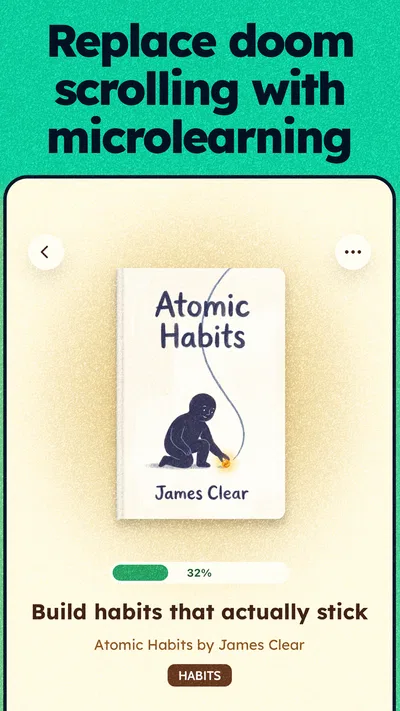
 Analysis byAppsAward
Our review of Deepstash: Smarter Every Day!
I like Deepstash best when I treat it as a place to encounter useful ideas, not as a shortcut to mastering a subject. It turns reading into small, approachable sessions: a thought or takeaway can be easier to fit between errands than a full chapter, and that low commitment makes it less likely that I’ll abandon learning for lack of time. The trade-off is important, though. Brief ideas can spark curiosity, but they cannot replace the context, evidence, or practice that deeper learning requires.
Ideas that fit into the gaps of a day
Deepstash is an education app from developer Deepstash, built around compact knowledge and book-inspired ideas. Its appeal is straightforward: instead of asking me to set aside a long stretch of uninterrupted time, it offers a way to read in short bursts. I can open it when I have a few spare minutes and leave with a prompt to think about, even if I do not have time to work through a whole book.
That format makes the app feel different from a conventional ebook reader. An ebook is better when I want an author’s full argument, a clear sequence, and enough room for examples and qualifications. Deepstash is more suited to sampling ideas across topics and deciding what deserves further attention. I see it as a starting point for curiosity rather than a replacement for reading in depth.
The experience is also distinct from taking a course. A course usually has a planned path, sustained lessons, and some expectation that knowledge will build from one session to the next. Deepstash is more casual: it fits a wandering learning habit, where I might explore something relevant to work today and a completely different subject tomorrow. That flexibility is convenient, but it puts more responsibility on me to connect ideas and follow through.
Why small takeaways can be useful
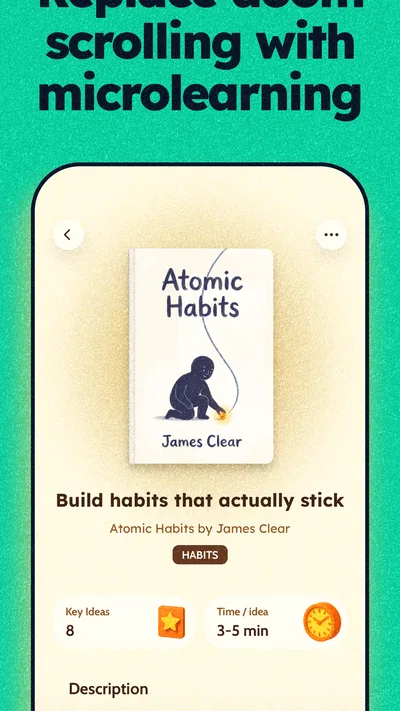
The strongest case for bite-sized reading is not that every idea can be understood in a few minutes. It is that a small entry point can make learning feel manageable. When I am tired or distracted, the prospect of a whole chapter can be enough to make me put my phone away and do nothing. A short read lowers that barrier, and an interesting takeaway can give me a reason to return to the topic later.
A practical way to use the app is to read with a question in mind. Before opening it, I might ask what could help me communicate more clearly at work or make a routine less frustrating. If an idea seems relevant, I can write down the thought in my own words and decide what situation I might try it in. That extra step matters: without it, short reading can become a pleasant stream of novelty that is difficult to remember.
For example, imagine I have a few minutes before a meeting and want to think more carefully about how I explain a proposal. I could use a short session to look for an idea about communication, then choose one specific thing to test—such as leading with the point I want colleagues to remember. The value is not that a brief read guarantees a better meeting. It is that the app can give me a prompt to carry into a real situation, where I can judge whether it helps.
This approach also makes Deepstash more useful for people who enjoy collecting questions. If a compact idea raises a “why” or “how” that it does not answer, I can treat that gap as a reading trail. The app’s short format is then a discovery tool: it helps me notice what I want to investigate, while longer books, articles, or structured lessons do the work of answering it.
What the format leaves out
The main limitation is the same quality that makes the app approachable: compression. A concise takeaway may be memorable, but a short presentation can leave out the reasoning and context that make an idea reliable or useful. A statement that sounds persuasive on its own may depend on caveats, a particular setting, or evidence that takes longer to explain. I would not use a brief summary as the final word on a complex or consequential subject.
That means I need to read actively rather than treating each idea as settled advice. I ask myself who the suggestion is intended for, what assumptions it seems to make, and whether it applies to my circumstances. If I cannot answer those questions, I treat the idea as a lead to investigate—not as a rule to follow. This is especially important when an idea concerns health, money, relationships, or professional decisions, where context matters more than a tidy takeaway.
There is also a difference between feeling informed and being able to use what I have read. Short sessions can create a satisfying sense of progress, but recognition is not the same as recall, and neither automatically becomes a skill. If I want to remember something, I have to revisit it, explain it in my own words, or apply it. Readers who want a carefully ordered syllabus may find that a course or a focused textbook provides more direction than a broad stream of small ideas.
Another trade-off is that a casual discovery habit can become scattered. Moving from one attractive subject to another is enjoyable, yet it can make it difficult to build a coherent understanding of any one field. I find it helps to give a session a small purpose—exploring one question, gathering ideas for a project, or deciding which book to read next. That keeps variety from turning into aimless browsing.
Who is likely to get the most from it
I would recommend Deepstash to curious readers who want a lightweight way to bring learning into ordinary pauses. It may suit someone who likes discovering ideas but struggles to make time for long reading sessions, or someone who wants a spark before deciding whether to explore a topic more seriously. It can also be useful for people who enjoy reflecting on a takeaway and testing it in everyday life, rather than expecting an app to do the thinking for them.
It is less suitable as a sole learning resource for anyone who needs a systematic progression, detailed explanations, or practice with feedback. If I were preparing for an exam, learning a technical skill, or trying to understand a difficult subject from first principles, I would choose a structured course, a reference book, or another resource designed for depth. Deepstash can help me identify questions and make a topic feel less intimidating, but it should not be mistaken for comprehensive instruction.
People who already read regularly may still enjoy the app as a discovery layer, especially when they want ideas outside their usual interests. But if a reader dislikes short-form content or prefers to follow one author’s argument from beginning to end, the format may feel too fragmented. In that case, a regular book or a long-form publication is likely to be more satisfying.
The app is free to download, with in-app purchases listed from $12.99 to $119.99 per item. I would begin with the free experience and decide whether the short-reading habit genuinely fits my routine before spending anything. The existence of paid options does not, by itself, tell me whether I will use the app enough to justify a purchase; that depends on how often I return and whether its content helps me take useful next steps.
What its audience and app details suggest
Deepstash sits in the education category, and its broad reach suggests that the format has found an audience: it has more than 5 million installs and an average rating of 4.6 from around 201,000 ratings. Those figures are useful context, but they do not tell me whether a particular reader will enjoy compact, idea-led learning. My own deciding question would be whether I want quick prompts for further thought or a more complete teaching experience.
It is rated for everyone, which makes the app broadly accessible as a reading experience, though suitability still depends on the individual and the subject being explored. The current version is 33.1.3, and the minimum operating system requirement is version 7.0. For someone considering an installation on an older device, that requirement is a practical detail worth checking before getting started.
Deepstash was released on April 16, 2019. Its continued presence in a crowded learning space makes the central appeal easy to understand: people often want an accessible way to encounter ideas without committing to a long session. Still, popularity cannot solve the key limitation of the format. The reader has to supply the context, judgment, and follow-up that compact learning cannot provide on its own.
My verdict: a useful spark, not a substitute for study
My overall view is positive, with a clear boundary around what I expect from it. Deepstash can make spare minutes feel more purposeful and help me find ideas I might want to explore further. Its best use is as a prompt: read something brief, decide whether it matters, and then connect it to a question or action. When I use it that way, the compact format is a genuine advantage rather than a reason to expect too much.
I would skip it if I wanted a complete course, a single authoritative source, or a reliable way to master a subject through brief reading alone. I would also be cautious about treating memorable summaries as universal advice. The app is most rewarding when curiosity is the goal and when I am willing to go beyond the first takeaway.
For a friend who wants a low-pressure way to discover ideas during the day, I would say it is worth trying. For a friend who needs depth, structure, or demonstrable skill-building, I would point them toward a more focused learning resource instead. Deepstash works best as a doorway into learning: easy to step through, but not the whole journey.
Pros
- Short reads make it easy to learn during spare moments.
- Personalized recommendations help surface relevant ideas.
- Topics span productivity and psychology as well as many other fields.
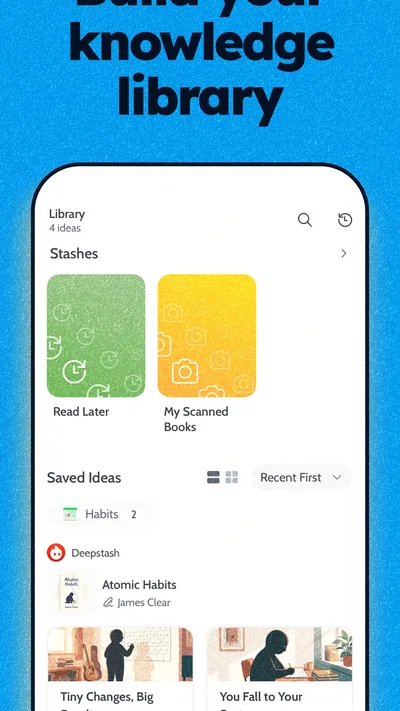
- Saved ideas can be organized into personal collections.
- A clean interface keeps browsing focused.
Cons
- Some content may feel too brief for deeper study.
- A subscription is required for access to some features.
- Recommendations may become repetitive over time.
- The app relies on an internet connection for much of its content.
- Ideas may lack enough context to assess their original sources.
Best Education App 2026
Our verdict
Bite-sized knowledge & books. Book summaries and big ideas in 5 minutes a day.
Frequently Asked Questions
What is Deepstash: Smarter Every Day!?
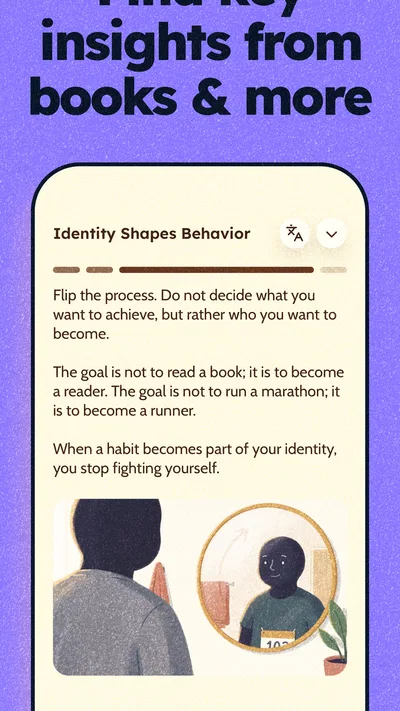
Deepstash is a learning and personal-growth app that turns ideas from books, articles, podcasts, and other sources into short, easy-to-read summaries called “stashes.” You can browse topics such as productivity, psychology, business, and wellbeing, then save useful ideas to your personal collection. It is designed for quick learning, rather than replacing the original books or other source material.
Is Deepstash: Smarter Every Day! free to use?
Deepstash can be downloaded and used without paying, though free access may include limits on certain features or content. The app also offers paid subscription options, which can provide benefits such as broader access to its library or additional learning tools. Availability and plan details can change, so check the current in-app pricing and subscription terms before signing up.
How does Deepstash help me discover and remember ideas?
The app presents concise ideas in a card-based format, making it convenient to read during a short break. You can explore recommendations, follow subjects that interest you, and save stashes for later. Its personalized discovery features may help surface relevant material over time, but remembering and applying an idea still depends on revisiting it and putting it into practice.
Can I use Deepstash offline or save content for later?
You can save ideas within the app so they are easier to find again, but saving an item to your collection does not necessarily mean it will be available offline. Offline access can depend on the app version, subscription, and how content is stored. If you expect to read without an internet connection, check the app’s current download or offline settings before relying on it.
What should I know about Deepstash’s content and privacy before downloading it?
Deepstash features condensed ideas based on material from a range of sources, so a stash is best treated as an introduction rather than a complete substitute for the original work. The app may also collect information related to account use, preferences, or activity to operate and personalize its services. Review its current privacy policy, permissions, and subscription terms to decide whether they suit you.

Download Deepstash: Smarter Every Day!
Similar apps
View all 9.5
Duolingo: Language Lessons
Education
 9.6
Gauth: AI Study Companion
Education
 9.2
Learn English, Spanish: Learna
Education
 9.1
ABCmouse: Kids Learning Games
Education